Note
Go to the end to download the full example code.
Denoisers and Plug-and-Play
Plug-and-Play (PnP) methods reconstruct with an iterative algorithm in which a denoiser takes the place of a regulariser. The denoiser is trained once, on clean images with added Gaussian noise, and works for any operator: the operator only appears in the algorithm.
This tutorial trains a denoiser with GaussianDenoiserSolver and
reconstructs with it (LION.reconstructors.PnP). Short runs, to show how.
Previous: Self-supervised training. Next: Learned regularisers.
Needs a GPU and the processed LIDC-IDRI data in LION_DATA_PATH; downloads
the authors’ trained DRUNet (130 MB).
Note
The models trained in these tutorials are toys: a few epochs on a few slices, to show how LION is used, so their results are poor (often worse than FDK). Trained as their papers train them (many epochs, all the data), they do what the papers report.
The data and the denoiser
The denoiser only uses the clean images (the targets of the experiment’s samples). DRUNet (Zhang et al., 2021) takes the noise level as an input, so one network denoises every level.
import tempfile

import matplotlib.pyplot as plt
import torch
from torch.utils.data import DataLoader, Subset

from LION.experiments import ct_experiments
from LION.metrics.psnr import PSNR
from LION.models.CNNs.drunet import DRUNet
from LION.optimizers.GaussianDenoiserSolver import GaussianDenoiserSolver

experiment = ct_experiments.LowDoseCTRecon()
training = Subset(experiment.get_dataset("train"), range(40))
validation = Subset(experiment.get_dataset("validation"), range(8))

training_loader = DataLoader(training, batch_size=4, shuffle=True)
validation_loader = DataLoader(validation, batch_size=4)

parameters = DRUNet.default_parameters()
parameters.use_noise_level = True
denoiser = DRUNet(parameters)
/mhome/damtp/r/ab2860/AItomotools/LION/data_loaders/LIDC_IDRI.py:487: UserWarning: LIDC-IDRI: left out 2 damaged or unusable files (re-run the pre-processing for these patients): ['LIDC-IDRI-0238 (not resampled)', 'LIDC-IDRI-0585 (not resampled)']
  warnings.warn(
Noise levels are in the units the denoiser sees. The literature’s (k/255) are for images in [0, 1], so the images are normalised to [0, 1] by their range over the training data. The normalisation is saved with the model and applied whenever it is used.
denoiser.set_normalisation("dataset", training)
Training the denoiser
GaussianDenoiserSolver adds the noise. Its parameters follow the
literature: one noise level per image, drawn from a range; random flips and
rotations; optionally random crops (patches) and random erasing; fixed noise
levels to validate at.
solver_parameters = GaussianDenoiserSolver.default_parameters()
solver_parameters.noise_level = [0.0, 50 / 255]
solver_parameters.patches = GaussianDenoiserSolver.patches(8, 128)  # 8 crops a slice
solver_parameters.validation_noise_levels = [15 / 255, 25 / 255]
print(solver_parameters)
noise_level : [0.0, 0.19607843137254902]
patches : n_patches : 8
patch_size : 128
augment : True
random_erasing : False
validation_noise_levels : [0.058823529411764705, 0.09803921568627451]
The loss: the papers use either. DRUNet is trained with the L1 loss; DnCNN,
FFDNet and the gradient-step denoiser with the L2 loss (MSE). None of them
adds a model_regularization (see “Jacobian penalties” below for the
papers that do). The L2 loss trains towards the MMSE denoiser
E[x | noisy x], the one PnP theory assumes (through Tweedie’s formula); the L1
loss towards the median, and often trains better (Zhao et al.).
L1, DRUNet: Zhang et al., “Plug-and-Play Image Restoration With Deep Denoiser Prior”, IEEE TPAMI, 2022.
L2, DnCNN: Zhang et al., “Beyond a Gaussian Denoiser: Residual Learning of Deep CNN for Image Denoising”, IEEE Trans. Image Processing, 2017.
L2, FFDNet: Zhang, Zuo and Zhang, “FFDNet: Toward a Fast and Flexible Solution for CNN-Based Image Denoising”, IEEE Trans. Image Processing, 2018.
L2, gradient-step denoiser: Hurault, Leclaire and Papadakis, “Gradient Step Denoiser for Convergent Plug-and-Play”, ICLR 2022.
L1 vs L2: Zhao, Gallo, Frosio and Kautz, “Loss Functions for Image Restoration with Neural Networks”, IEEE Trans. Computational Imaging, 2017.
l1_loss = torch.nn.L1Loss()  # DRUNet
l2_loss = torch.nn.MSELoss()  # DnCNN, FFDNet, GS denoiser
loss_fn = l1_loss
The solver doesn’t use the operator, but takes its parameters, recorded as the problem the denoiser was trained for.
folder = tempfile.mkdtemp()
solver = GaussianDenoiserSolver(
    denoiser,
    torch.optim.Adam(denoiser.parameters(), lr=1e-4),
    loss_fn,
    operator_params=experiment.operator_params,
    solver_params=solver_parameters,
    model_regularization=None,  # none of the papers above; see "Jacobian penalties"
)
solver.set_training(training_loader)
solver.set_validation(validation_loader, 1, PSNR(), validation_fname="DRUNet_best")
solver.set_saving(folder, "DRUNet")
solver.train(3)
solver.save_final_results()
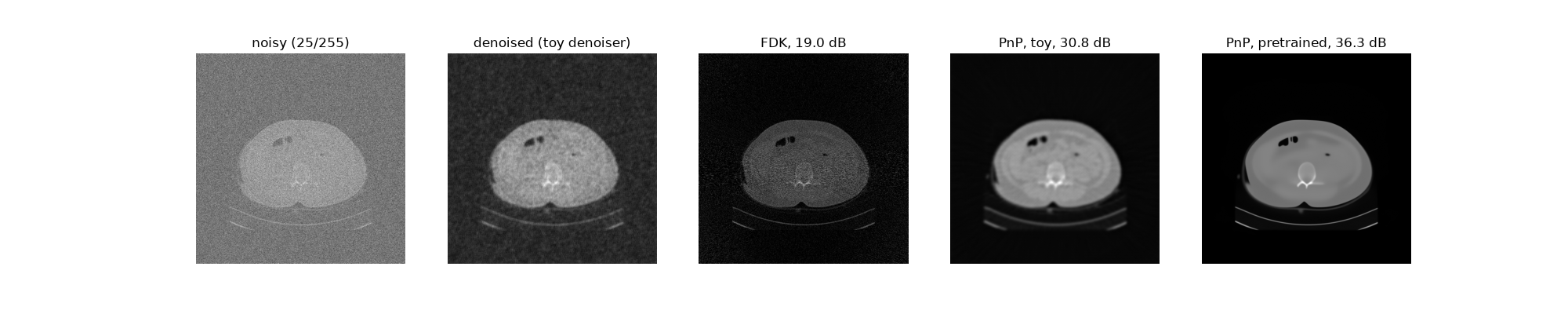
Denoising a validation image at 25/255. LION’s solvers and reconstructors normalise for the model; called by hand, the model takes normalised images:
image = validation[0][1]
x = denoiser.normalise(image[None])  # to [0, 1], as the denoiser sees it
noisy = x + 25 / 255 * torch.randn_like(x)
denoiser.eval()
with torch.no_grad():
    denoised = denoiser(noisy, noise_level=25 / 255)
Jacobian penalties
PnP methods are proven to converge when the denoiser has a property a network
doesn’t have on its own: being firmly nonexpansive or a proximal operator. A
penalty on the denoiser’s Jacobian, given to the solver as its
model_regularization, trains it towards that. Both papers use the L2
loss, train without the penalty first, then add it:
FirmlyNonexpansivePenalty: Pesquet, Repetti, Terris and Wiaux, “Learning Maximally Monotone Operators for Image Recovery”, SIAM J. Imaging Sciences, 2021.ProximalDenoiserPenalty: Hurault, Leclaire and Papadakis, “Proximal Denoiser for Convergent Plug-and-Play Optimization with Nonconvex Regularization”, ICML 2022.
Fine-tuning the trained denoiser with one of them:
from LION.losses.jacobian_penalty import (
    FirmlyNonexpansivePenalty,
    ProximalDenoiserPenalty,
)

# Pesquet et al., on a DnCNN with leaky ReLUs: weight 1e-5, epsilon 0.05
firmly_nonexpansive = FirmlyNonexpansivePenalty()
# Hurault et al., on a gradient-step DRUNet: weight 1e-3 or 1e-2, epsilon 0.1
proximal_denoiser = ProximalDenoiserPenalty(weight=1e-3)
model_regularization = firmly_nonexpansive

solver = GaussianDenoiserSolver(
    denoiser,
    torch.optim.Adam(denoiser.parameters(), lr=1e-5),
    l2_loss,  # both papers
    operator_params=experiment.operator_params,
    solver_params=solver_parameters,
    model_regularization=model_regularization,
)
The gradient-step denoiser (LION.models.PnP.gradient_step_denoiser.GSD)
wraps any denoiser N as x - grad g(x), g(x) = ½||x - N(x)||²: the
denoiser ProximalDenoiserPenalty is for.
Plug-and-Play reconstruction
PnP takes the operator (or its parameters), the denoiser and the
algorithm’s parameters: ADMM, HQS or FBS (forward-backward splitting).
from LION.operators.ct import fdk
from LION.reconstructors.PnP import PnP

pnp_parameters = PnP.default_parameters("ADMM")
print(pnp_parameters)
pnp_parameters.max_iter = 20
pnp_parameters.noise_level = 10 / 255  # the denoiser's, in its [0, 1] units
# eta, ADMM's weight between the data and the prior, is by default relative to
# the operator: 1e-2 ||A||² (larger trusts the prior more)
pnp = PnP(experiment.operator_params, denoiser, pnp_parameters)

sinogram, image = validation[0]
reconstruction = pnp.reconstruct(sinogram)
# or one algorithm with its settings given:
# reconstruction = pnp.admm_algorithm(sinogram, max_iter=20, noise_level=10 / 255)
algorithm : ADMM
initial_reconstruction : default
eta : None
max_iter : 10
cg_max_iter : 100
cg_tol : 1e-07
noise_level : None
A pretrained denoiser
The denoiser above is a toy, trained for 3 epochs on 40 slices: a poor prior. The DRUNet its authors trained on natural images (a 130 MB download, on images in [0, 1]) is a good one, and the same reconstructor with it shows what PnP does:
HQS and FBS are used the same way:
algorithm : FBS
initial_reconstruction : default
step_size : None
max_iter : 10
noise_level : None
psnr = PSNR()
fbp = fdk(sinogram, experiment.operator_params)
fig, axes = plt.subplots(1, 5, figsize=(20, 4))
shown = [
    ("noisy (25/255)", noisy[0]),
    ("denoised (toy denoiser)", denoised[0]),
    (f"FDK, {psnr(fbp, image, batched=False):.1f} dB", fbp),
    (f"PnP, toy, {psnr(reconstruction, image, batched=False):.1f} dB", reconstruction),
    (
        f"PnP, pretrained, {psnr(pretrained_reconstruction, image, batched=False):.1f} dB",
        pretrained_reconstruction,
    ),
]
for ax, (title, x) in zip(axes, shown):
    ax.imshow(x[0].cpu(), cmap="gray")
    ax.set_title(title)
    ax.axis("off")
A reconstructor is saved with pnp.save(file): its settings, and its model
by the file it was loaded from (Saving, loading and records).
Total running time of the script: (1 minutes 16.161 seconds)